GarageOS — garage operations on a deterministic scheduler kernel
Not a calendar but a machine: a 12-stage deterministic tick, delay propagation across the whole board and a 32-fixture conformance suite that proves every scheduling decision by replay.
Problem
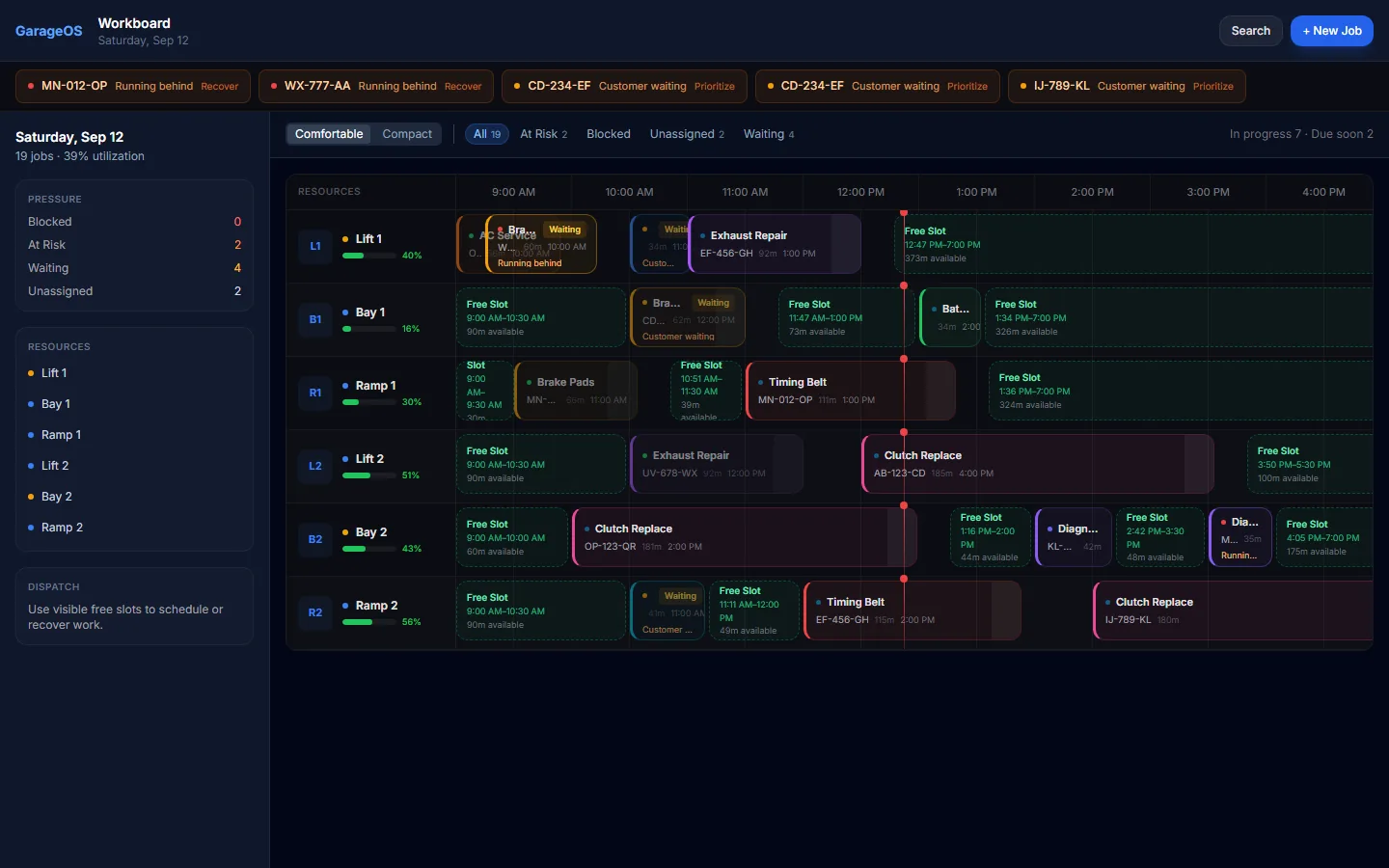
Most garage software is a painted grid: you drag blocks onto a timeline and hope. One late job leaves the rest of the board blind, free time is not a visible resource, and when something breaks you start over. The Nisbel Autostuudio pilot showed this in a real shop.
System
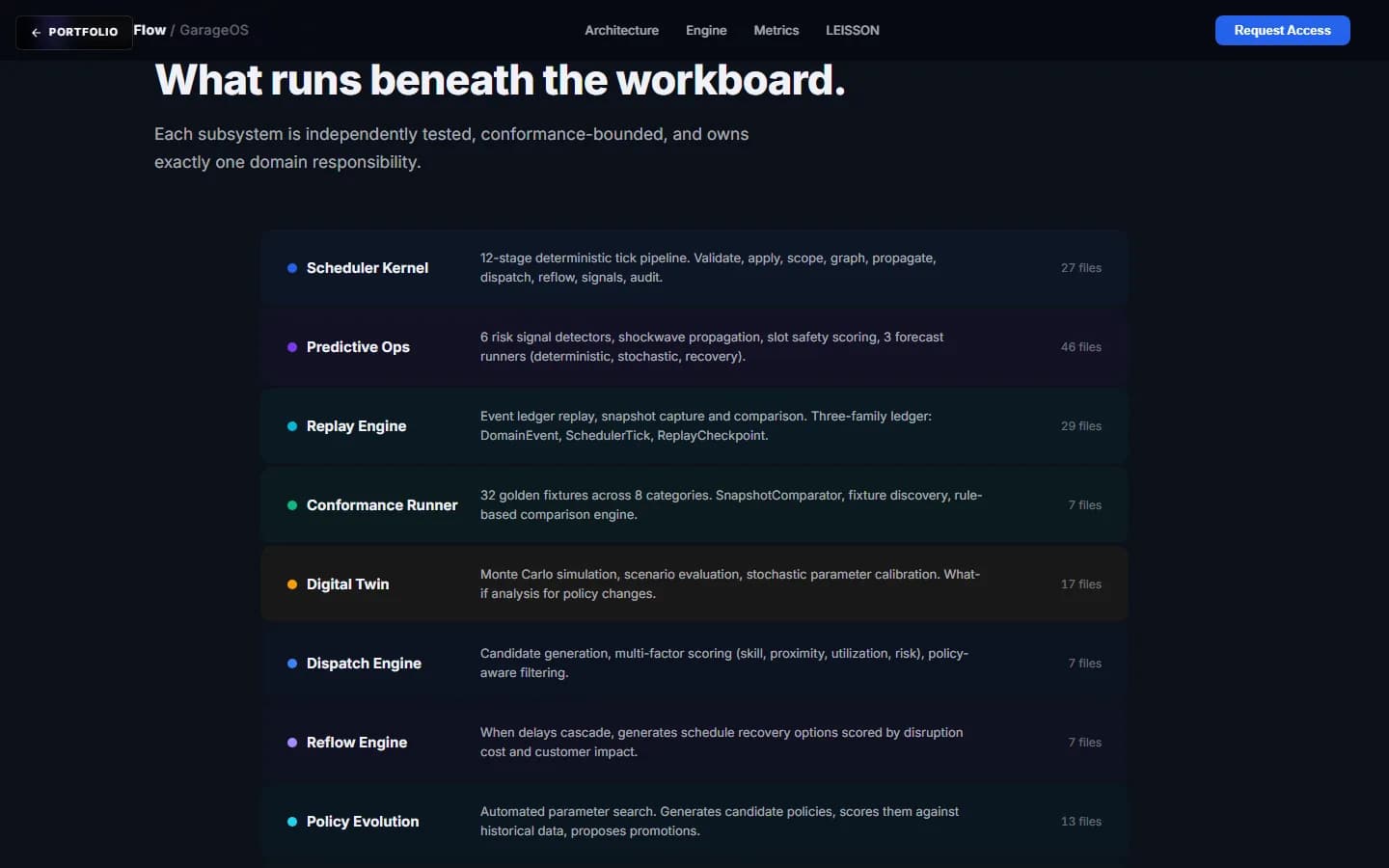
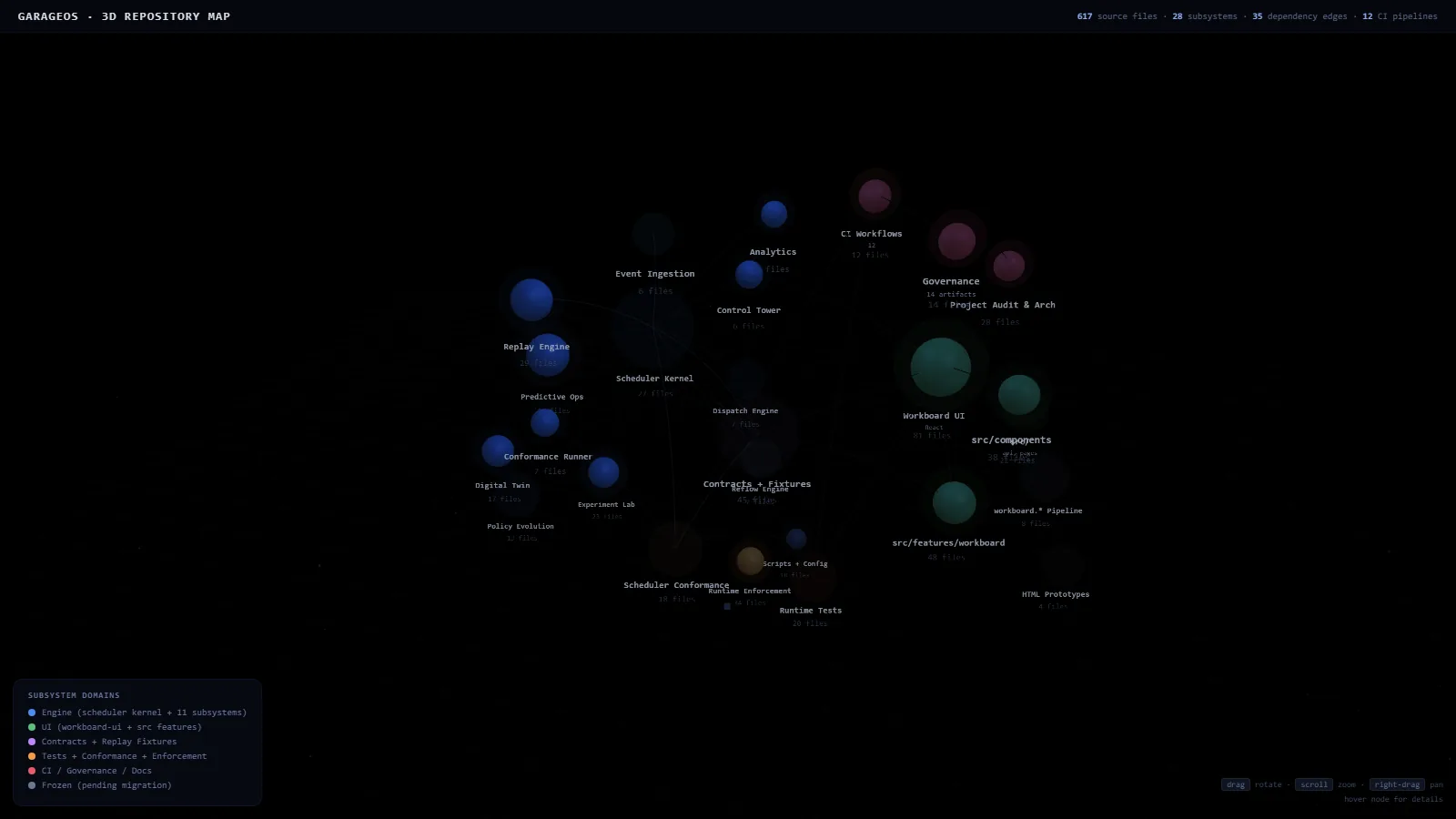
GarageOS is kernel-first: a deterministic scheduler runs a 12-stage tick (validate, apply, scope, graph, propagate, dispatch, reflow, signals, audit) and the UI renders the truth. A delay on job A propagates as a “shockwave” of forecasts across the board; 6 risk-signal detectors and 3 forecast runners (deterministic, stochastic, recovery) propose reflow candidates. Every open interval is a visible, bookable resource. Smart dispatch ranks candidates by skill, proximity and risk. Every kernel change is replay-proven against 32 fixtures. The 3D repo map shows 617 files, 28 subsystems, 35 dependency edges and 12 CI pipelines.
Decisions
Kernel before screen: scheduling logic must be testable without a UI. The event ledger and replay are first-class citizens — “untestable scheduling logic” is not allowed. The status is “Concept”: demo pages and architecture exist, there is no production deployment; the site says so directly.
Metrics
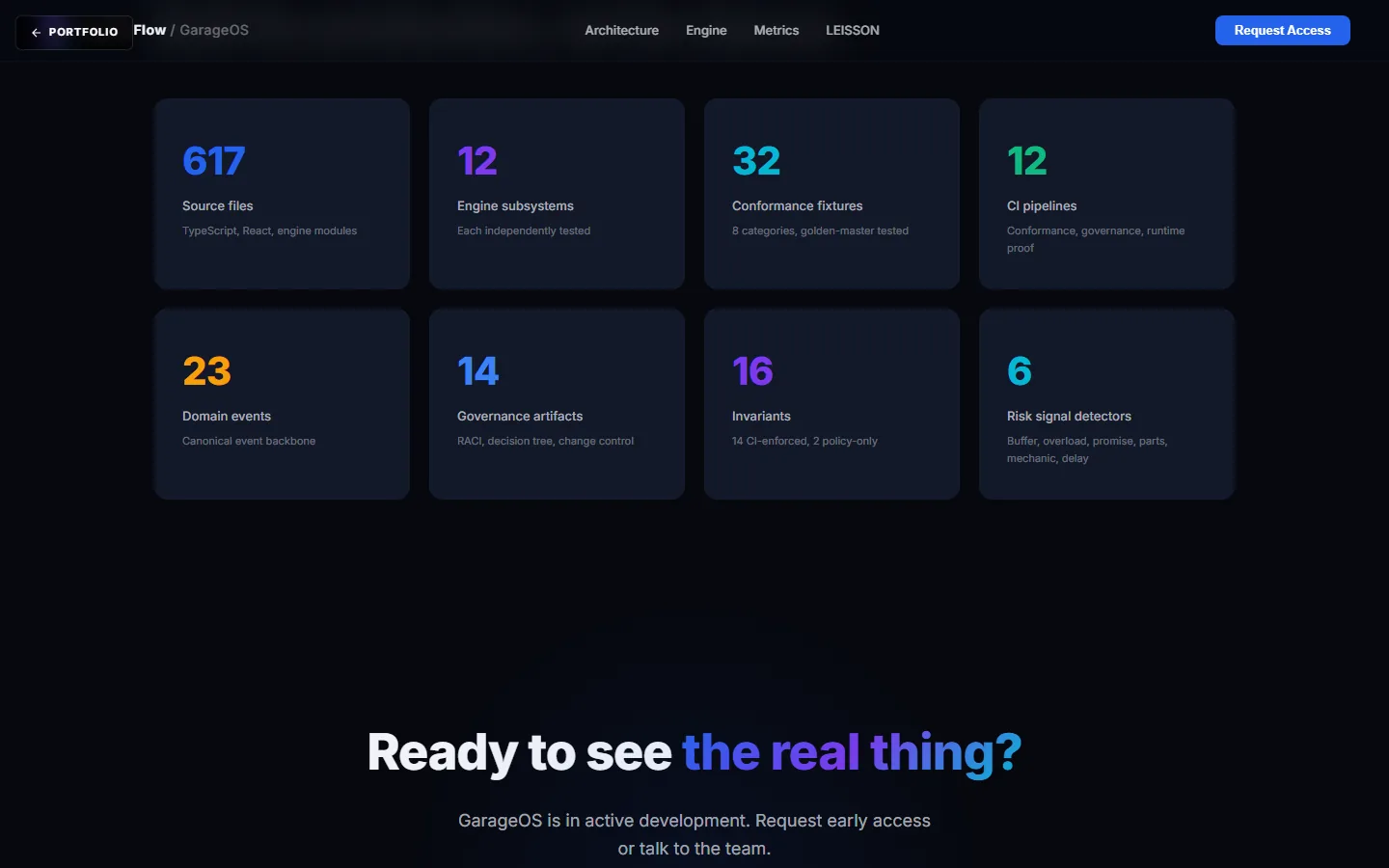
12 stages, 32 fixtures, 617 files / 28 subsystems / 35 edges / 12 pipelines (source: autofix-intro.html, garageos-repo.html).
Stack
Next.js, Tailwind, shadcn/ui, PostgreSQL, Three.js (3D repo map).
Product screens
GarageOS is a concept: these are its own surfaces, captured from the local prototypes on 12 September 2026 — workboard, engine page, numbers page and 3D repository map. The product itself does not exist yet. There are no phone screens, because these surfaces are built desktop-first.